Jake Reveals His Progressive Vision Loss
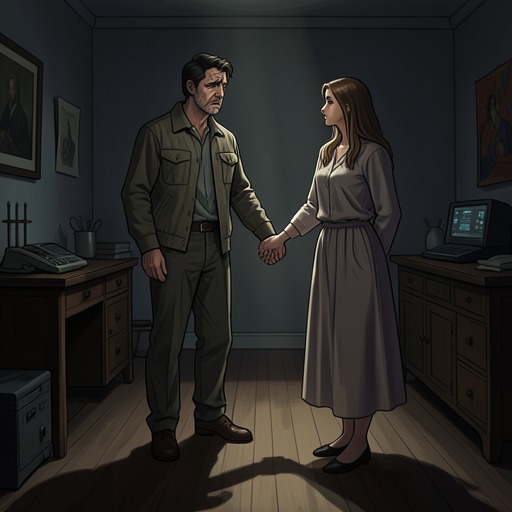
Happiness for BeginnersJake Reveals His Progressive Vision Loss is the moment Jake tells Helen that he is going blind, transforming a search for a pair of glasses into a disclosure of the future he has been carrying alone. The news emerges not in a planned conversation but after he disappears from the group while fetching water. As the light fades beside a rocky creek, Helen finds him frightened and unable to see her; she stays with him, hears the diagnosis and its prognosis, and helps him recover his glasses. The scene binds the practical fact of his failing sight to the fear of losing independence, while a sudden kiss makes their closeness newly difficult to dismiss.
The Search at the Creek
The disclosure begins during camp setup. Jake has taken four water bottles and a cookpot down a footpath to fill them at the creek. When he has not returned by the time the tarp is ready, and evening is closing in, Helen grows concerned. She tells the rest of the group she will help him, although nobody is paying attention. The task has turned into a search: Jake is alone on a steep, uneven route where the rocks shift underfoot and the path seems to double back on itself.
Helen reaches the bottom before finding him. Jake is on his hands and knees, panting; his eyes are red, and he has apparently fallen. When he looks up, he does not see her. He warns her not to come closer because he has lost his glasses and fears she will step on them. The missing object immediately changes the scale of the mishap. Without it, Jake cannot reliably locate Helen or the glasses themselves, and a small accident on a difficult trail leaves him visibly distressed. Helen moves toward him despite his warning, then follows his attempt to keep her at a distance by calming him rather than pressing him with questions.
Fear, Disclosure, and Prognosis
Once Helen is close enough, Jake grabs her and pulls her into a crushing embrace, holding his face against the space between her neck and shoulder. His breathing is frantic; Helen pats his back and reassures him while the evening grows colder and darker. The embrace lasts until his breathing settles. Its importance lies in the contrast between Jake’s usual self-sufficiency and this moment of dependence: here, he reaches for another person before he can explain what has frightened him.
Jake says that he should not be on the trip. Helen thinks of the medical report he falsified, and the subject leads him to explain why he first signed up, canceled, and then enrolled again. He had canceled because of trouble with his eyes. After examinations and tests, he learned that he had an inherited vision disorder that could not be fixed. He identifies the condition as Jake’s retinitis pigmentosa and tells Helen that, over the next few years, he will lose his sight. The account makes the prognosis explicit: this is not a temporary problem caused by the fall or the missing glasses, but a progressive loss he expects to continue.
When Helen asks about treatment, Jake tells her there is none. He has spent the past year searching through available information with the knowledge he gained from pre-medical training. He has reached a stark conclusion: he can only wait for his sight to go. Helen’s shock follows from the distance between the news and the capable, independent person she knows. Her thoughts turn to ordinary tasks the future may complicate—choosing clothes, buying groceries, traveling from home to work, and finding a book to read—as well as the question of how he will use his formidable intellect. The scene does not answer those questions; it lets Helen confront them as consequences of a prognosis she cannot reverse.
Jake’s explanation also clarifies the significance of the false medical report. Helen connects it to his earlier cancellation and to his not going to medical school; Jake calls the deception stupid. The exchange makes clear that he has concealed the condition while continuing on the wilderness trip, even as the group has been surrounded by practical discomforts that Helen now recognizes as comparatively minor. His diagnosis has accompanied him through the hike, but the others have not known what he is facing. The disclosure alters what Helen can understand about his presence on the trail without supplying a complete account of every decision he has made.
Touch, Sight, and the Recovered Glasses
The rain begins as a sprinkle while they are talking. Jake says that he hates not being able to see Helen at that moment. Helen answers by taking one of his scratched, callused, dirt-covered hands and placing it against her face. He raises his other hand and feels along her jaw, cheekbones, eyebrows, and nose, closing his eyes as he concentrates. He recognizes her through touch. The exchange does not restore his sight or offer a substitute cure; it gives the two of them a way to meet in the immediate circumstances of the scene, when vision is unavailable and physical contact becomes a means of recognition.
Afterward, Jake remembers that he has lost his glasses. With daylight running out, Helen gets down on her hands and knees to search. She discovers that she has been kneeling over them and has snapped one arm off. The lenses, however, are intact. She puts them in Jake’s hand; he wipes them on his shirt and puts them on, reacting with relief when he can see her again. The glasses return the scene briefly to its practical problem, but their broken frame also marks the vulnerability of the object on which he depends in this moment. Finding them resolves the immediate crisis, not the progressive disorder he has just described.
The Kiss and Its Immediate Aftermath
As soon as his glasses are back on, Jake pulls Helen into another full-body hug. He then changes the embrace into a kiss without asking first. Helen experiences it as markedly different from their earlier motel kiss: this one is intense and anxious, and she understands it through the knowledge of Jake she has gained rather than as contact with a stranger or merely her brother’s friend. The timing connects the kiss to the disclosure and the relief of seeing her again, but the narrative does not reduce it to either of those things. It occurs amid fear, physical closeness, and a sudden recognition of how much Jake matters to her.
Helen also remembers that Jake is dating Windy and pushes him away, telling him that kissing is not a good idea. Jake apologizes and says he should not have done it; Helen is breathless but not angry. She acknowledges the boundary and the possibility that they have crossed it, while also giving both of them some allowance for a moment that neither had planned. She then proposes that it never happened. Jake agrees, adding that they do many things that never happened. Helen wonders whether he and Windy are together and whether the kiss amounts to cheating, but does not ask. The scene therefore ends without resolving their relationship status: the diagnosis has been spoken plainly, while the kiss is placed under a shared denial that leaves its emotional consequence intact.
Narrative Significance
The scene’s movement from an ordinary camp errand to a personal revelation depends on the gap between what the group sees and what Jake has concealed. At first, the missing water and the fading light are the visible problems. The glasses then expose a more immediate dependence: without them, Jake cannot see Helen, and he is afraid she will destroy the very object he needs. Only after Helen reaches him and helps him steady his breathing does he disclose the longer, irreversible danger behind that moment.
Helen narrates the encounter from her own perspective, so Jake’s diagnosis reaches the reader through her questions, shock, and imagined picture of his future. Her response moves from seeking a treatment to recognizing that none exists, and from imagining what blindness will make difficult to offering her face for Jake to identify by touch. The broken glasses restore his view of her for now; the rain-soaked kiss shifts their friendship into a more charged, uncertain intimacy. Neither gesture changes the prognosis. Together, they show what the disclosure does change: Helen’s understanding of the burden Jake has been carrying, and the terms on which she and Jake can no longer pretend that nothing happened.